2026 Flagship School

Bringing early-career neurochemists together with leading experts for scientific exchange, mentorship and international connection.

The International Society for Neurochemistry (ISN) will hold the sixth ISN Flagship School from September 11–15, 2026, in Armação dos Búzios, Brazil. This year’s program will focus on “Glial Cells: from Molecules to Medicine.”

The 2026 ISN Flagship School offers an intensive five-day learning experience for around 40 early-career researchers (PhD students and postdocs) selected through a competitive application process. Participants will explore recent advances in neurochemistry through lectures, group discussions, and poster sessions, working closely with leading scientists in the field.

Organised as part of ISN’s global education program, the Flagship School fosters scientific exchange, mentorship, and collaboration among young neurochemists from around the world.

The application period is now closed.

School Chairs

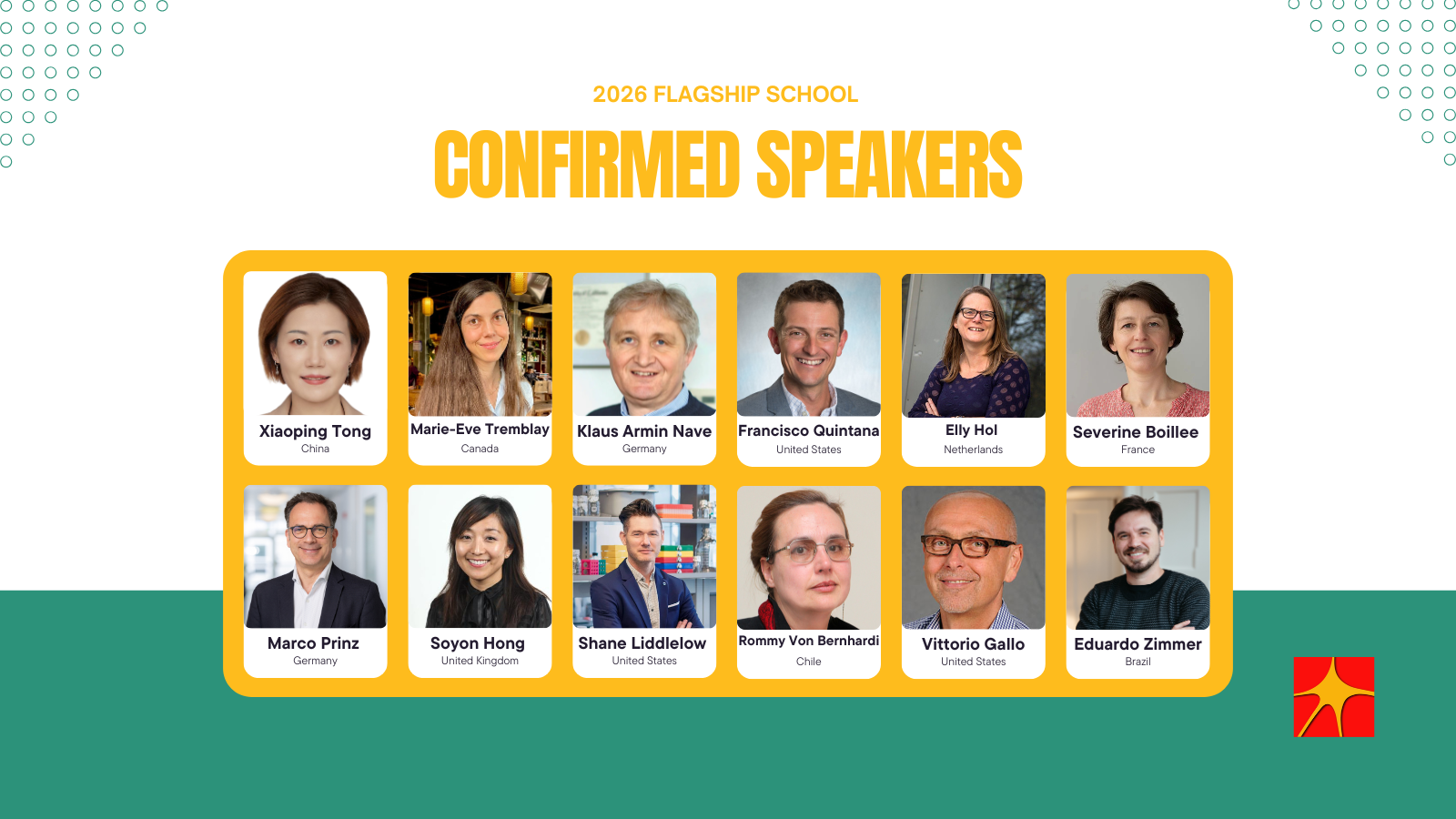
  • Xiaoping Tong (Topic: Glial neuronal interactions / New arising techniques to study glial cell function) – Professor, School of Medicine, Shanghai Jiao Tong University Shanghai, China
  • Marie-Ève Tremblay (Topic: New arising techniques and models to study glial cell function) – Professor & Canada Research Chair (Tier I) in Neurobiology of Healthy Cognitive Aging, University of Victoria, Canada
  • Klaus Armin Nave (Topic: Oligodendroglia) – Professor of Molecular Biology; Director, Max Planck Institute for Multidisciplinary Sciences, University of Göttingen, Germany
  • Francisco Quintana (Topic: Astrocytes) –  Associate Scientist, Brigham and Women’s Hospital, Professor of Neurology, Harvard University, Associate Member, Broad Institute, USA
  • Elly Hol (Topic: Glial cells in different disease states) – Vice-Dean of Research, University Medical Center Utrecht, Professor of Glia Biology of Brain Diseases, Utrecht University, Netherlands
  • Séverine Boillée (Topic: Glial cells in different disease states) –  Team Leader / Principal Investigator, Paris Brain Institute Research Officer, INSERM, France
  • Marco Prinz (Topic: Microglia ontogeny and physiology) –  Professor of Neuropathology, University Hospital Freiburg, Germany
  • Soyon Hong (Topic: Microglia ontogeny and physiology) – Group Leader, UK Dementia Research Institute, University College London, United Kingdom
  • Shane Liddelow (Topic: Astrocytes) – Associate Professor, Department of Neuroscience, Associate Professor, Department of Ophthalmology, NYU Grossman School of Medicine, USA
  • Rommy von Bernhardi (Topic: Glial cells in different disease states) – Professor, Universidad de Santiago de Chile (USACH), Faculty for Chemistry and Biology, Lab. Neural Systems.
  • Vittorio Gallo (Topic: Oligodendroglia) – Senior Vice President & Chief Scientific Officer, Research Division and Seattle Children’s Research Institute, USA
  • Eduardo Zimmer (Topic: Glia and biomarkers for neurodegenerative diseases) – Assistant Professor, Federal University of Rio Grande do Sul, Brazil

Selection and Support

Up to 40 young scientists from around the world will be selected based on academic excellence. Successful applicants are expected to attend the full duration of the school.

Participation in the ISN Flagship School is free of charge. Accommodation will be provided, and participants will receive financial support based on region, to help cover travel expenses to Brazil.

Application Requirements

When applying, candidates will need to submit the following:

  1. Motivation Letter (around one page; up to 450 words): Explain why participating in the 2026 ISN Flagship School on “Glial Cells: from Molecules to Medicine” is particularly relevant to your current work and career development.
  2. Scientific abstract of the poster to be presented at the school.
  3. Curriculum Vitae (around one page; up to 450 words; do not include a publication list).
  4. List of up to five recent publications.

Eligibility

  • Please note that the application is only open for ISN Student Members (PhD students with at least one year of lab experience in their PhD project) and for ISN Postdoc Members (up to 5 years after the year the doctoral degree was awarded).
  • All interested young scientists are encouraged to apply for the 2026 ISN Flagship School. However, priority will be given to high-quality applications from ISN members who have not attended previous schools organised by the society.
  • Only active ISN members are eligible to apply. Not an ISN member yet? Apply here.

*If you are not an ISN member yet, please note that the membership application process may take some time, so we recommend applying well in advance of the school application deadline.

*ISN offers a membership fee waiver for members of its regional societies – APSN, ASN, and ESN.

Enquiries

Specific questions about your application should be directed to the ISN Office at secretariat@neurochemistry.org.