Join Jazmin, Postdoctoral Fellow in the Department of Neuroscience and Anatomy at the Virginia Commonwealth University School of Medicine, and Marta, Postdoctoral Researcher at Université de Sherbrooke, as they sit down with Associate Professor Shane, from the Departments of Neuroscience and Ophthalmology at NYU Grossman School of Medicine, for a thoughtful discussion on how the brain ages at the cellular level.
They explore what senescence really means in the context of neurochemistry, how different brain cell types, and even different brain regions, age in distinct ways, and why functional changes in cells may matter more than traditional molecular markers. Drawing on Shane’s work on astrocytes and neuroinflammation, the conversation highlights how cellular aging intersects with neurodegeneration, brain resilience, and disease.
The interview offers a nuanced look at why brain aging is far from a single, uniform process, and why understanding it requires thinking beyond simple definitions.
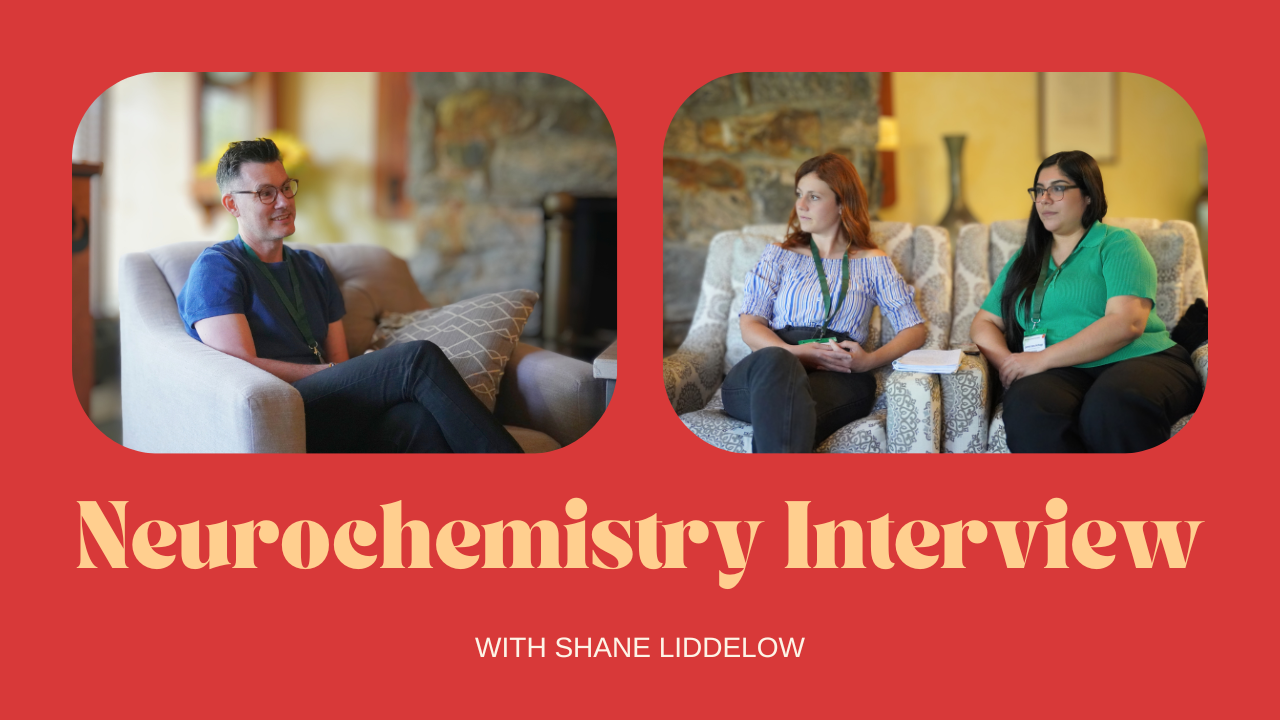
Jazmin Verdugo and Marta Turri in conversation with Shane Liddelow during a neurochemistry interview on brain aging and senescence.
Jazmín: What is senescence, from your perspective?
Shane: That’s such a hard question, but I like that you said from my perspective. I think senescence is a whole suite of changes that occur in cells as the organism ages.
These can be changes in gene expression, proteins, lipids, or in what the cells do – what they secrete, how they respond. It’s a normal part of aging that happens at the cellular level.
Shane: Now I’m going to flip it. What do you think senescence is?
Jazmín: I’d go in the same direction: changes in genes and proteins in cells at different stages of aging. But I think it differs between cell types.
For example, neurons don’t really go through a classic cell-cycle arrest like oligodendrocyte precursors, or maybe someastrocytes can. So, the hallmarks you see in each cell type won’t necessarily be the same. That’s how I think about it.
Shane: I like that description. Marta, what about you?
Marta: I have a similar point of view. I work more on aging in general, but I think it can start with a different transcriptome profile that’s driven by specific cell types and the signals they’re sending.
Shane: Yeah, I really like these answers – especially the idea that individual cells, and different cell types, might age differently and have different kinds of senescence.
Jazmín: We know you’re an expert in astrocytes, but we were wondering about other cell types too. Do you see differences across brain regions?
Shane: Yes, and one of the things I find interesting about aging in astrocytes is that they don’t all seem to age the same way. If you take astrocytes from different regions of the brain at the same time point, they look different. Some may have turned on what we’d consider senescence markers, or reactivity markers, or inflammatory markers in the hippocampus, but not yet in the cortex. Or maybe they’re on in the striatum but not in the hypothalamus. That suggests that even the same cell type might age or become senescent at different rates in different brain regions, and probably in different ways. I think that’s interesting.
And that’s just astrocytes. Is the same true for oligodendrocytes, neurons, microglia, blood vessels? And then if you think beyond the brain, across other organs, it’s a huge question.
Most of us, including my lab, start by sequencing because it’s relatively cheap and easy. But then you must ask: do those gene changes actually do anything? Is the function of the cell perturbed? Can it still do what it’s supposed to do – form synapses, support circuits, etc.? That’s the part that makes aging or senescence dangerous: the functional change, not just the transcriptome.
Marta: Following that, do you think some brain areas or organs age earlier than others?
Shane: My knees age faster than the rest of my body – they hurt more in the morning.
But seriously, if we go back to astrocytes, work from Nicola Allen at the Salk and Laura Clarke, who was a contemporary of mine in Ben Barres’s lab, showed that in very old mouse brains, astrocytes in regions classically associated with degeneration, like the hippocampus or striatum, have a more pro-inflammatory, reactive profile than those in regions like the frontal cortex.
Does that mean those regions are aging faster? Maybe. Or it could just be a response to what’s happening there with other cells.
My feeling is that each region ages in the way it needs to, to accommodate changes in that region. Similarly, each organ ages in a way that fits the stresses it’s been exposed to.
Our skin ages quickly because of sun exposure. My liver probably ages more because I drink too much wine. Overall, aging might actually be appropriate for each organ system, even if it doesn’t feel that way to us.
Jazmín: We were talking yesterday about trying to slow aging, not stop it. We asked about the hallmarks of aging, but specifically for senescence, what would the hallmarks be? And also, what is actually the difference between aging and senescence?
Shane: That’s a great question. Now, what do you think the difference is?
Jazmín: Aging feels like a natural, general process. Senescence sounds like some kind of biological end point for certain cells or systems, but I’m not sure how to define it.
I’ve been using the terms interchangeably. I think they overlap a lot. Some of the hallmarks we saw today, in Flavia’s talk, looked like hallmarks of disease, hallmarks of senescence, and hallmarks of aging all at once.
So maybe it’s something like: all enzymes are proteins, but not all proteins are enzymes. They’re related, but not the same.
Shane: That comparison is perfect. I really like it.
Aging, we often think of as deterioration. Things getting old, breaking down, eventually dying. Senescence, in contrast, can just be a state of cellular change – when cells irreversibly exit the cell cycle and stop dividing, but don’t die.
In the brain, it’s extra tricky because so many cells are post-mitotic already. Neurons are mostly post-mitotic. Astrocytes and oligodendrocytes are largely post-mitotic. So are they “senescent” from early in life, or is senescence something else—like a functional state?
For me, the more useful distinction is: Aging: broad, time-related deterioration of the organism. Senescence: a state where cells stop dividing and/or change their function, but remain alive.
So a senescent oligodendrocyte might have less compact myelin, leading to conduction problems. A senescent astrocyte might be worse at glutamate uptake and recycling, which can be really detrimental. They’re not dead, and they still do some of their jobs—just not as well, and that dysfunction may be the key thing to understand. So I think of senescence as dysfunction, not death.
Jazmín: So it’s really about the end point: what that state looks like functionally?
Shane: Exactly. We also talked about premature aging, which might itself be a form of senescence – cells changing function earlier than expected without necessarily dying.
A lot of this is semantics and nomenclature, and people do use the terms interchangeably. My guess is that we’ll eventually have better, more precise terms, probably based on function or cell-type-specific markers, rather than these big umbrella words “aging” and “senescence.”
Marta: Our next question is: do we all age in the same way? And if not, why do people age differently?
Shane: Great question. Absolutely not! We don’t all age the same way. Genetics plays a big role, it’s always genetics, but environment and epigenetics matter a lot too. There was a study of truck drivers where the side of the face exposed to the sun through the window was much more aged than the other side. That’s a dramatic environmental effect. Diet is another factor. People on a Mediterranean diet, or traditional Japanese diets with a lot of fish, often appear to age more “youthfully” on average. Again, what is “youthful”? But they don’t look as aged, and that tracks with lifestyle.
Then you have extreme examples: someone who smokes until they’re 100 and seems fine, and someone who looks very old at 70. So, understanding how genetics and environment interact will be really interesting.
Across species, it’s even stranger. Lobsters and some jellyfish appear to evade typical aging patterns. Greenland sharks can live for hundreds of years. Whales live a long time; dolphins, not as long. Naked mole-rats outlive similar rodents. Aging is very species-specific, and we don’t fully understand why.
So no, we are definitely not all aging the same way.
Jazmín: In the aging cascade in the CNS, do you think the CNS influences the peripheral system, or the peripheral system influences the CNS?
Shane: Both. definitely both.
From the periphery to the CNS: peripheral inflammation strongly affects the brain. Sepsis is a classic example: it’s a peripheral bacterial infection, but it has huge central nervous system consequences. In experimental models, an intraperitoneal injection of LPS (lipopolysaccharide) causes major changes in the brain. Diabetes can lead to neuropathies.
From the CNS to the periphery: changes in brain function can modify behavior. If someone is depressed, they may be less able to exercise, go outside, or interact socially. That will influence physical and cognitive aging. Dementia is another example: central degeneration reduces a person’s ability to engage with the world, which then accelerates physical decline.
So yes, it absolutely goes both ways.
Marta: Thinking from the “outside in,” do you think we’ll have a magic pill for aging one day? Instead of exercising, could we just take something like an irisin pill?
Shane: This is one of those moments where I’ll say, “No, I don’t think there’ll ever be a pill for aging,” and then one day someone will invent one and that quote will haunt me.
I would love to be wrong. It would be wonderful if older people could stay healthier longer and if we could reduce the aches, pains, and frailty that come with age.
But I don’t think there will be a single pill, just like there isn’t one pill for Alzheimer’s, one pill for Parkinson’s, or one pill for every neurological condition. Biology is complicated. Aging is not one process – it’s many. If we ever have “pills for aging,” my guess is it will be a combination of therapies: one that reduces senescence or modifies senescent cells, one that helps the liver regenerate, one that preserves cartilage, one that maintains skin structure, and so on. Each one would target a different aspect of aging. We’d probably end up taking several. And in the end, the simplest “pill” is still: eat more vegetables, exercise more, and stay engaged with life – annoyingly!
Jazmín: And more specifically at the cellular level, since different cells have different timing for becoming senescent or aging, can we reprogram them, from a harmful to a protective or less senescent state?
Shane: In principle, yes. Think of it as “gene-editing away aging.” We can’t realistically do that in patients in most countries, but in animal models we absolutely can. We have beautiful AAV tools to target specific cell types. We can overexpress or knock down genes and quickly change pathways. As a tool, this works very well in the lab – in yeast, bacteria, mice, etc.
There are classic experiments where overexpressing a single protein, like klotho, globally in a mouse extends its lifespan. So, there are definitely levers in the system.
Would I want that kind of gene therapy in myself? Probably not. Humans live for decades, so long-term side effects could be serious. That’s why we tend to reserve gene editing for severe diseases, not something like “normal” aging. And context is everything. In our work, neurotoxic astrocytes are bad in Alzheimer’s disease, they kill neurons. But in viral or bacterial infections, you actually want them, because they attack infected regions and stop the infection from spreading.
So we might think, “Let’s get rid of all the ‘bad’ astrocytes,” but biology will always say, “It depends.”
Jazmín: If we really improve healthy aging, doesn’t that raise questions about population size and limits? You might get 60 or more years of healthy life- how do we handle that?
Shane: The planet is already pretty full. We definitely can’t all live forever. Еven if we said, “Okay, humans can live to 120,” you then have a quality-of-life question: would you rather have 60 really good years, or 120 years where things slowly get harder? There’s no easy answer.
Jazmín: And people living in less developed countries age under very different conditions.
Shane: Absolutely. Socioeconomic status has a huge impact on aging. Physically demanding jobs accelerate physical aging. Having many children is physically demanding. Lack of healthcare and limited diet diversity all contribute.
On the other hand, scientists in air-conditioned offices aren’t physically stressed in the same way but are under chronic mental load, which might help maintain cognitive function to some degree, because mental activity is protective against cognitive decline.
Different systems can age differently too. You’ll often see someone whose body is quite frail, but whose mind is very sharp, or the reverse. That’s different systems aging at different rates.
From an evolutionary perspective, we were “designed” to survive long enough to reproduce and raise offspring. After that, evolution doesn’t particularly care what happens. Society does, and that’s why modulating aging and senescence is such an important question for us.