
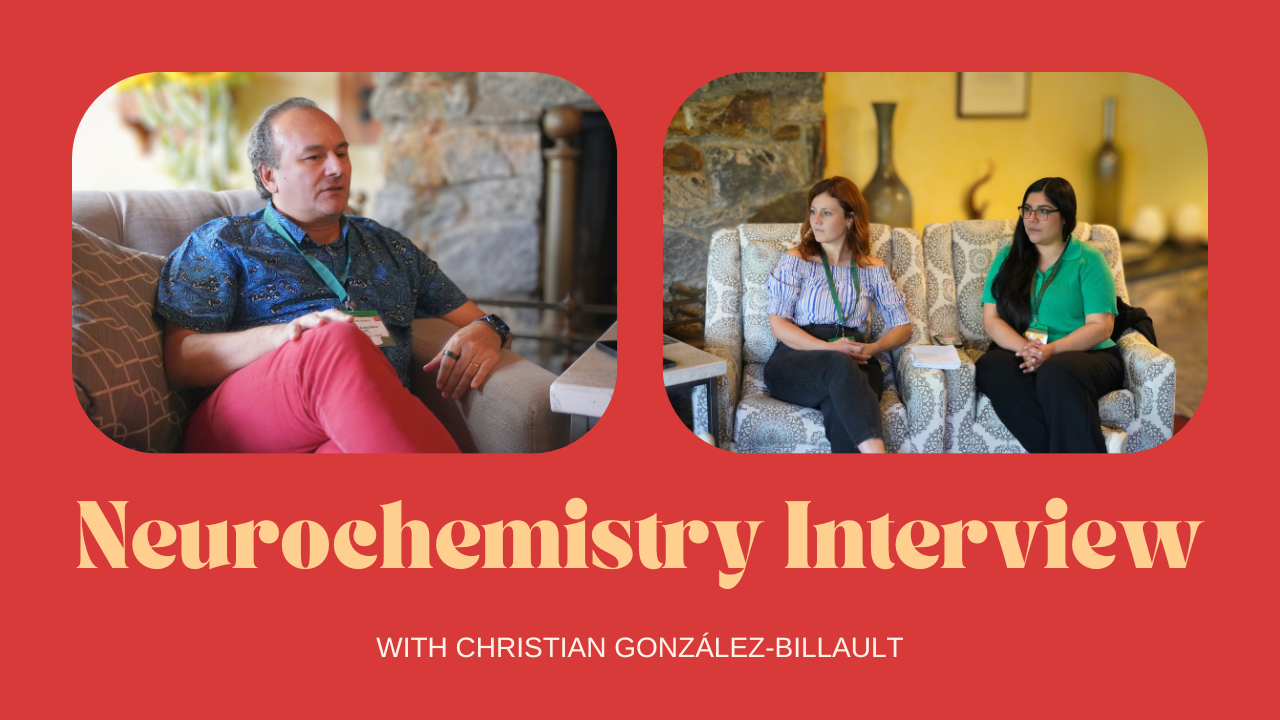
Join Jazmin, Postdoctoral Fellow in the Department of Neuroscience and Anatomy at the Virginia Commonwealth University School of Medicine, and Marta, Postdoctoral Researcher at Université de Sherbrooke, as they speak with Christian González-Billault, University of Chile, about what aging really means – from the cellular level to society at large..
In this wide-ranging conversation that took part during the ISN Advanced School, Christian reflects on how aging is defined, why there is still no universal consensus in the field, and how functional decline, metabolism, and lifestyle are deeply intertwined across the lifespan. The discussion explores whether aging should be considered a disease, how interventions such as caloric restriction and metabolic modulation may influence aging trajectories, and what current clinical efforts are teaching us about extending healthspan rather than lifespan.
Moving beyond biology alone, the interview also touches on the social dimensions of aging, including inequality, access to healthcare, and why thinking about aging should start far earlier than we tend to assume. Together, this conversation offers a thoughtful perspective on aging as a malleable, lifelong process – one that can be shaped by both biology and choice.
Marta: To start, what is aging?
Christian: That’s not an easy question. As we discussed yesterday, there is no real consensus on what aging is, even among researchers in the field.
From my point of view, aging can be defined as a functional decline that living organisms experience along their life trajectory. This decline is associated with a reduced capacity to cope with different stressors, both internal and external.
In a way, this connects to one of the most accepted theories of aging, which is antagonistic pleiotropy. The idea is that organisms are equipped with a finely tuned set of genes, proteins, and molecular systems that are essential to preserve the species. Once reproduction has occurred, those systems gradually begin to decline, because, evolutionarily speaking, we’ve already fulfilled our purpose.
Jazmín: What would be the main hallmarks of aging that most people would agree on?
Christian: The first important thing to say is that all hallmarks of aging are interconnected. When we talk about proteostasis, mitochondrial dysfunction, nutrient sensing, chronic inflammation, or epigenetic alterations, at some point they intersect.
A problem in one hallmark will inevitably impact the others. From that perspective, it’s not always easy to rank which ones are more important. We do know that some hallmarks may be more primary, while others appear more as secondary consequences, but they are all tightly linked.
Marta: Another challenging question: can we consider aging a disease?
Christian: That’s a great question. According to some researchers, yes. One of the main arguments is that if we don’t define aging as a disease, then it becomes very difficult to run clinical trials aimed at targeting aging. Regulatory agencies like the FDA won’t approve trials in “healthy” people.
This perspective is very research-oriented: if aging is a disease, then in principle we could try to cure it.
However, I personally find it difficult to reconcile this idea. Aging starts the moment we are born – actually, even during embryogenesis, we are already aging. Something that happens to everyone, all the time, from the very beginning of life, is hard to define as a disease. Accepting aging as a disease would force us to redefine what a disease is.
Marta: Can we tackle aging? And if so, how should we approach it?
Chritstian: Yes, there are ways to tackle aging. Interestingly, many of them have been known for a very long time. The most efficient intervention across species, from yeast to humans, is caloric restriction.
This idea didn’t start in the 1950s with experiments in monkeys. It goes back several centuries. There was an Italian nobleman named Luigi Cornaro who wrote a book called Discorso della vita sobria, in which he described lifestyle changes he adopted in his 30s or 40s that allowed him to live close to 100 years in the 16th century, which was extremely rare at that time.
So the short answer is yes: we can tackle aging, at least in part, by modifying our habits.
Marta: There’s growing evidence that aging is tightly linked to lifestyle and metabolic conditions like diabetes, dyslipidemia, and obesity, which are also risk factors for neurodegenerative disorders. Should metabolism be considered an early target for intervention?
Christian: I would say metabolism is central. Metabolism controls how cells manage energy flow, produce energy, and generate the building blocks needed to sustain life.
That said, you could make a similar argument for other hallmarks of aging, because metabolism is integrated with many other cellular processes.
I always use the same example when teaching cell biology. No matter which signaling pathway you study, it eventually affects one of three things: gene expression, metabolism, or cytoskeletal dynamics. These are core cellular processes that integrate multiple inputs and generate outcomes.
Metabolism is particularly relevant because it is closely linked to lifestyle – nutrition, exercise, sleep. These factors influence metabolites directly, and they give us multiple points of intervention, both pharmacological and non-pharmacological.
Jazmin: Are there any preclinical or clinical studies currently treating aging?
Christian: There are some trials. One that hasn’t started yet is the TAME trial – Targeting Aging with Metformin. It will be led by Nir Barzilai here in New York.
The idea is that non-diabetic, non–insulin-resistant individuals take metformin to prevent or delay some consequences of aging. It’s a kind of preventive strategy.
There’s strong evidence from animal models that metformin has beneficial effects, although interpreting human data has been more challenging.
Another compound that works very well in animal models is rapamycin. Unfortunately, rapamycin has significant side effects, making it unsuitable for widespread use. However, derivatives known as rapalogs are being developed.
One example comes from a company called RestorBio, led by Joan Mannick. They showed that administering a rapalog before influenza vaccination in older adults improved antibody responses. Since immune responses decline with age – a phenomenon known as immunosenescence – this suggests that rapamycin derivatives can partially rejuvenate immune function.
Jazmín: Do you think we’ll have a magic pill for aging anytime soon?
Christian: I hope not. I don’t like the idea of waiting for a pill to solve everything. Many effective interventions require commitment, perseverance, and lifestyle changes – and human nature makes that difficult.
If we rely on a pill, people may compensate with unhealthy behaviors, potentially negating its benefits. I think we are better off pushing the limits of healthy aging through multiple approaches rather than expecting a single solution.
Jazmin: So it’s not about stopping aging, but about improving quality of life?
Christian: Exactly. Lifespan is the time from birth to death. Healthspan is the period of life spent free of disease. Healthspan is always shorter than lifespan.
A recent Lancet paper analyzed data from 180 countries and showed significant gaps between lifespan and healthspan. In Chile, for example, that gap is around 11 years. This means that people live many years with functional decline and disease.
This highlights the idea that aging is malleable. There are things we can do, if we want to, to improve how we age.
Christian: Let me ask you a question. If you had unlimited resources, what would be your first priority in aging research?
Marta: I would start by targeting healthy populations and raising awareness. Early and mid-life interventions could make a huge difference, not to stop aging, but to age better.
Jazmin: I agree. I would also start clinical studies across different stages of life, 20s, 30s, 40s, to understand aging trajectories and build a roadmap toward better outcomes. Aging is natural, and stopping it raises ethical issues. Improving how we age feels more realistic and fair.
There’s also the question of access: who would benefit from these treatments? That’s not trivial.
Christian: That’s why metformin is interesting-it costs about 50 cents per pill. We also make a big mistake by only worrying about aging when we’re 65. We start aging in childhood. Ideally, we should begin thinking seriously about aging as soon as adolescence ends.
Jazmin: And aging isn’t only physical – mental and social aspects matter too.
Christian: Absolutely. There’s growing work on the social hallmarks of aging. Eileen Crimmins at USC has published important research showing how social inequalities affect biological aging.
This is especially relevant in Latin America, where access to education, healthcare, and social services is highly unequal. These social factors directly influence biology.
Jazmin: And averages can hide a lot. That 11-year gap in Chile probably underestimates the reality for low-income populations.
Christian: Exactly. When we work with averages, we miss critical information.


